
Plant noise
Air source heat pumps, North West
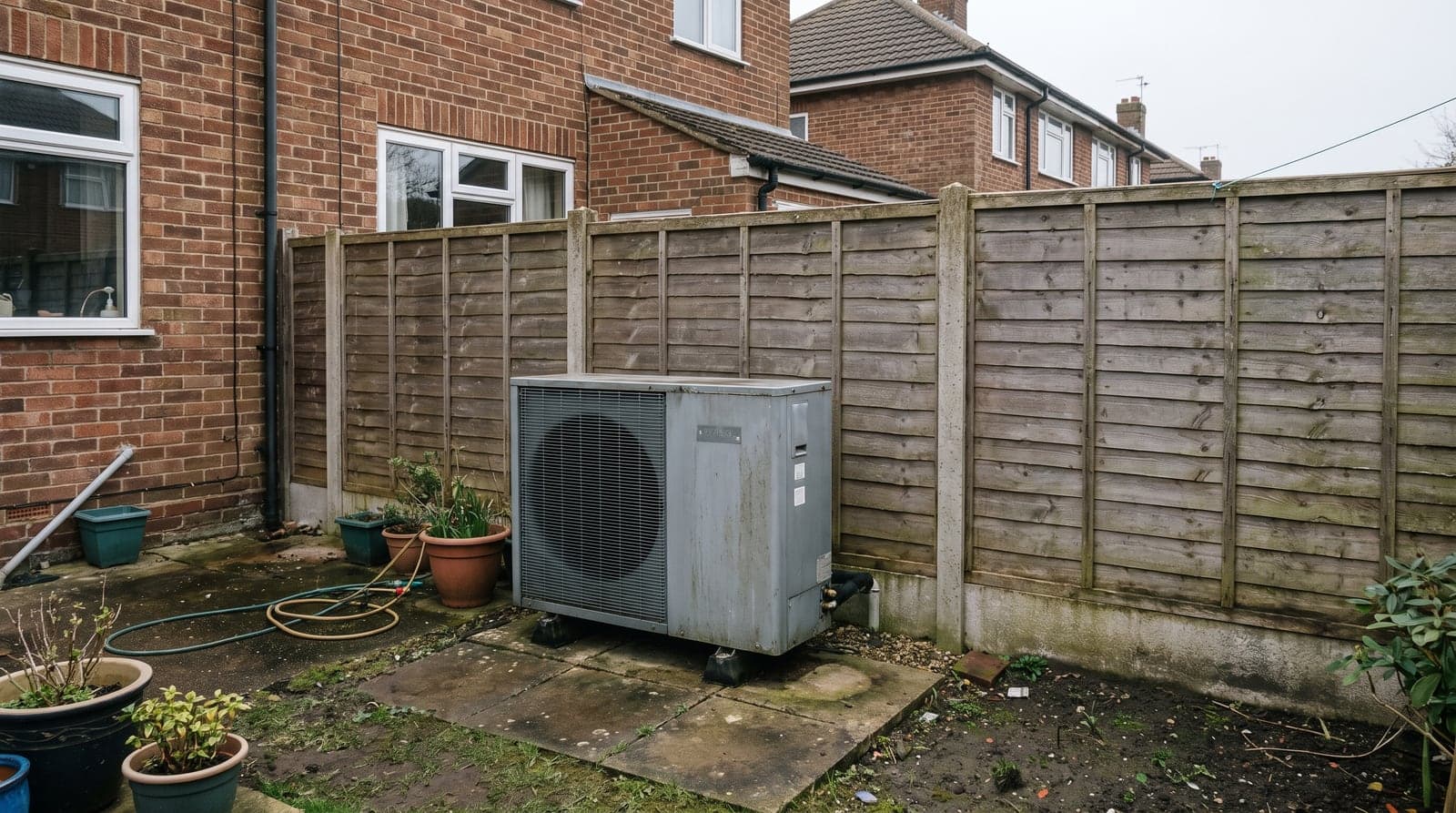
Eight heat pumps already installed, neighbours objecting, and a retrospective application to save.
Assessed against
- MCS 020(a) Issue 1.0
- WHO Night Noise Guidelines for Europe (2009)
- WHO Guidelines for Community Noise (1999)
The challenge
A housebuilder had already installed heat pumps at eight plots on a small scheme, and applied to regularise them after the fact. Residents at two of the plots objected, and these were not vague complaints. They asked, specifically, for an assessment against the recognised heat pump standard, and for all the units to be assessed running at the same time rather than one at a time. The council's environmental protection team backed that point. Residents also reported hearing the units indoors at night.
There was a genuine technical problem underneath. The recognised standard for domestic heat pump noise is written for installations that can lawfully go ahead without a planning application, which was precisely what this was not. The obvious alternative is written for industrial and commercial noise and its thresholds are calibrated for factories, not houses. Neither fits cleanly.
The original application had also quoted the wrong kind of figure for the units: a number that looks like a noise level but measures something different, and cannot be used in the calculation.
What we did
We used the heat pump standard anyway, and said why: its threshold traces back to World Health Organization guidance, it is the established limit for domestic heat pumps, and, decisively, it was the benchmark the objectors had asked for. Answering an objection on the objector's own chosen terms is far stronger than answering it on terms they will dispute.
We corrected the source figure to the manufacturer's declared value, then took distances from the drawings and worked each unit through to a point outside the nearest window of each affected home, allowing for whether anything actually blocks the view between them.
The standard only requires assessment at the *neighbours'* windows. Given the objections, we went further and included each household's own unit as well, and summed all eight running simultaneously at every position, eleven positions in total. That is the worst case the objections had asked about, and more besides.
The outcome
Every position came in under the threshold, with all eight units running at once, on deliberately pessimistic assumptions. The worst position also sat below the World Health Organization's night-time guideline, which spoke directly to the reported night-time disturbance.
The report also drew a line that mattered to the case. Noise and vibration carried into a house by its *own* heat pump is not a planning matter about a neighbour's amenity. In planning terms it is no different from your own boiler or extract fan, and it belongs to the installer under the installation standards and the Building Regulations. That kept the planning question separate from the workmanship question, which is what allowed the council to determine the application.
The authority received a compliant, cumulatively assessed set of positions and a point-by-point answer to every acoustic objection raised.
A similar project on your desk?
That is genuinely enough to price most jobs. You will have a fixed quote back the same working day.