Project updates
Astley Business Park: the full survey report.
Four nights of measurement beside the estate, and the assessment nobody made. Rated to BS 4142, the sound reaching the nearest gardens at night sits 18 dB to 26 dB above the background. The whole report is here to download, and this is what it says.
Murray Acoustics was instructed by the Astley Warehouse Action Group, a group of residents living around Astley Business Park in Tyldesley, Wigan, to survey and assess operational noise from the estate and to review the noise assessment that supported its planning permission. The work was done without charge to the residents. Neither Jamie Murray nor Murray Acoustics Ltd has any commercial or personal interest in the site, in the development, in its developer or in any of its occupiers.
The report is published in full. It supersedes the interim technical note we issued on 6 August, which was expressly preliminary and limited to night-time maximum levels. Where the two differ, the report prevails. This page sets the report out in plain terms; every number on it is the report’s own.
The document
Operational Noise Survey & Assessment: Astley Business Park
21184-RP-NIA-01 · Issued 19 August 2026 · 57 pages, 10.3 MB
Download the PDFThe appendices carry the working: the survey results night by night, the weather observations behind the decision to use two nights and set two aside, the BS 4142 reference method results for the published night interval by interval, and a glossary.
The night the report assesses can also be heard. A Night in Astley plays the survey’s own calibrated recording second by second, 22:00 to 06:00, against the measured levels, so any reader can judge the sound for themselves rather than take the attribution on trust.
The short version
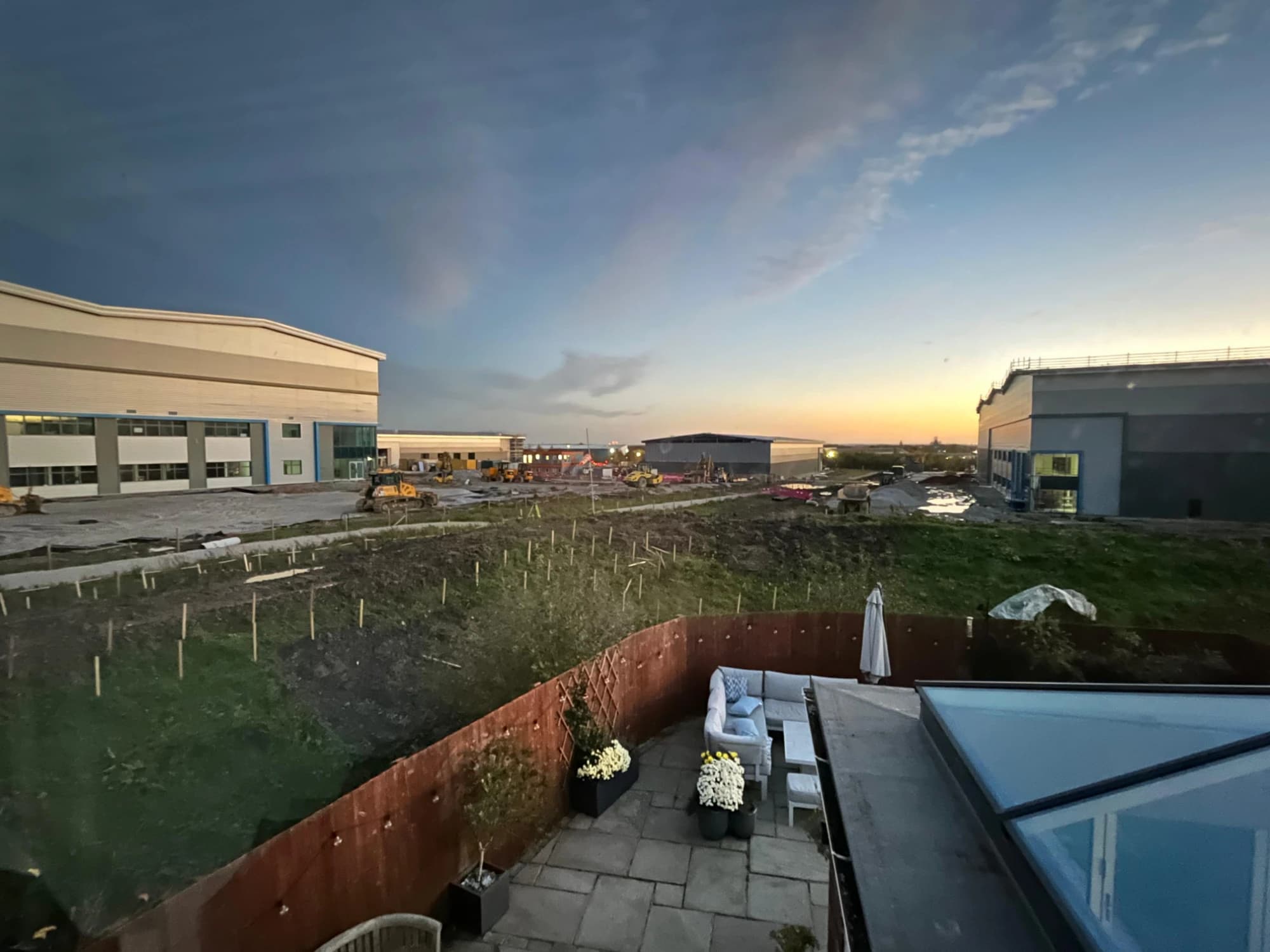
- The unit nearest the houses has been occupied and in 24-hour operation since about the end of March 2026. Its service yard, with its loading docks, faces the rear gardens of Withington Drive, which adjoin the western site boundary. The permission carries no noise limit, no restriction on hours or deliveries, no noise management plan and no monitoring requirement. Its one noise condition secures a length of acoustic fencing shown on a figure.
- BS 4142 is the British Standard for rating and assessing industrial and commercial sound, and its scope names the loading and unloading of goods in terms. The approved assessment identified it as the applicable standard and then applied it to the building services plant only, not to the service yard and heavy goods vehicle activity that its own predictions show to be the dominant source at night.
- Applied to that source, on the approved assessment’s own predicted level and its own background sound level, the standard would have returned a difference of around +10 dB before any correction for the character of the sound. That is the difference the standard associates with a likely significant adverse impact.
- We measured continuously for four nights in July 2026 from a garden at the closest dwelling. The background sound level of 34 dB the approved assessment adopted is corroborated by those measurements, and is if anything generous to the site: the contemporaneous value is 32 dB.
- Rated to BS 4142, the sound of the site at that garden exceeds the background by +18 dB to +26 dB with the corrections the sound attracts, and by +9 dB to +13 dB with no correction at all. That is so in a typical fifteen minutes of the night and not only in the worst.
- On the approved assessment’s own basis, its own criterion and its own receptor, the night-time maximum level it predicted at the nearest bedroom window is exceeded by around 20 dB.
Where the measurements were made
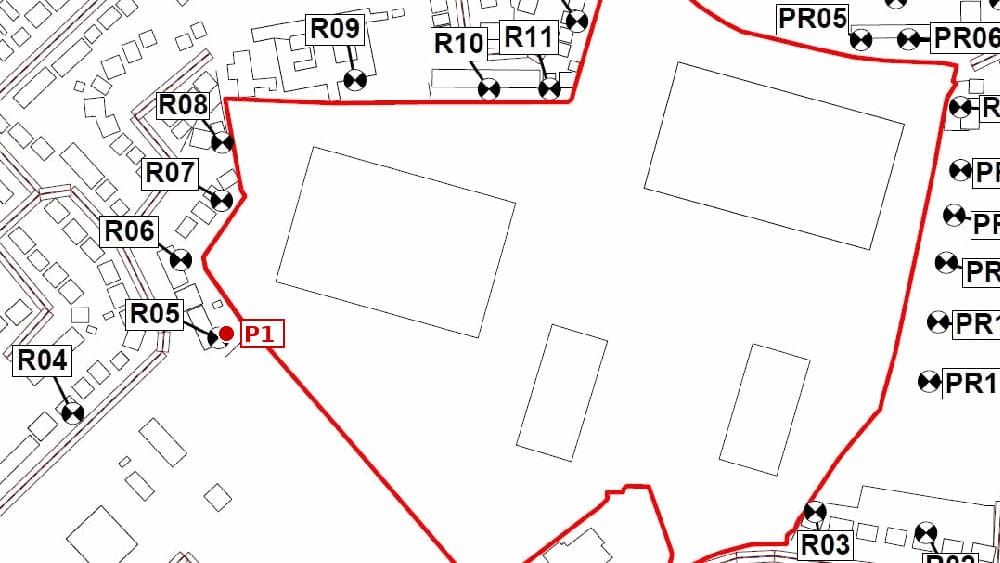
The approved assessment identified 27 representative noise sensitive receptors around the site. Receptor R05, 38 Withington Drive, is the closest and the worst affected by the current occupation. The survey position, P1, sits in that dwelling’s rear garden with the householder’s consent, about 22 m from the western site boundary and about 15 m from the rear of the house, with the microphone at 2.5 m in free-field conditions.
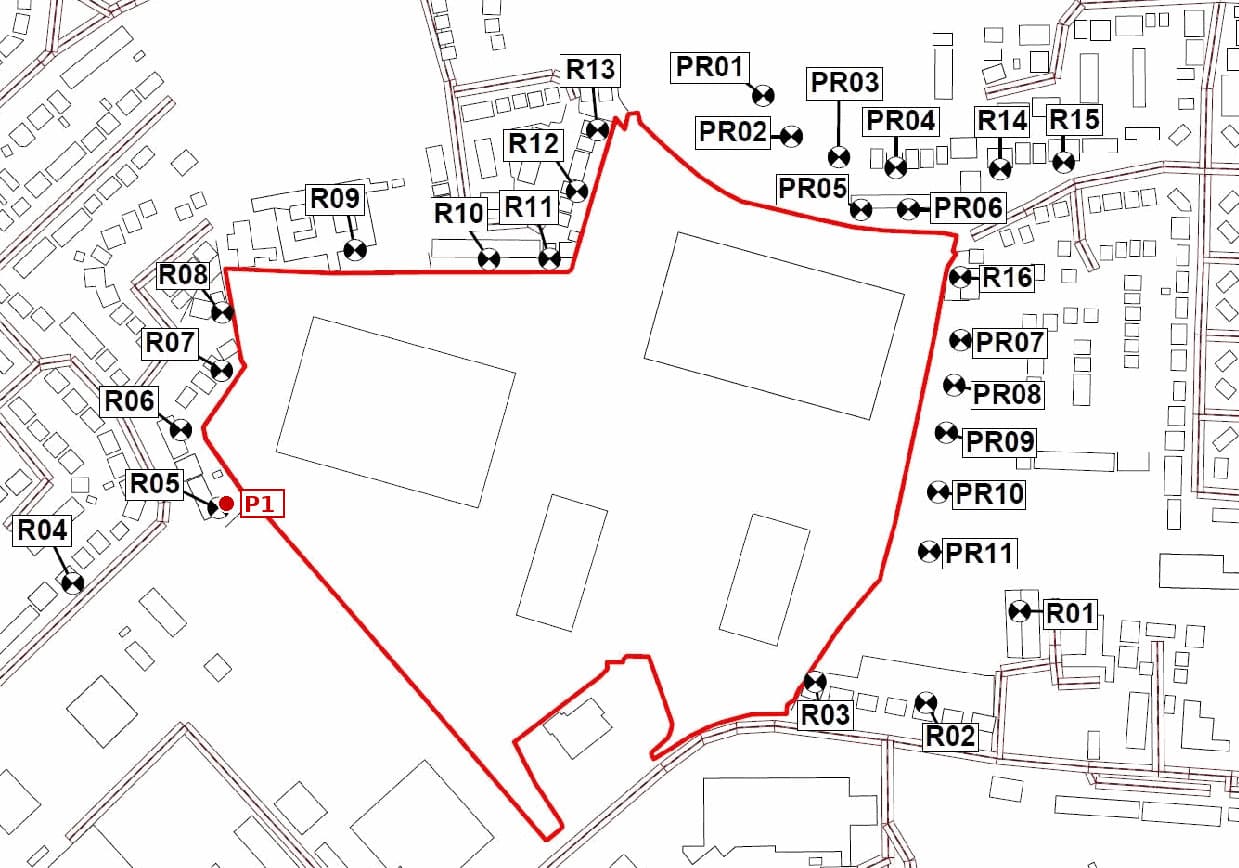
P1 is not where the approved assessment made its night-time predictions. Those are at 4.0 m above ground and 1 m from the façade, representing first-floor bedroom windows. The measurement position is lower and closer to the boundary screening, where that screening works better, so the levels reported from it understate the levels at the bedroom windows of the same house. Nothing in the assessment corrects for that, which leaves every margin in this report conservative in the site’s favour.
Measurement ran continuously from 12:30 on Saturday 25 July 2026 to 06:15 on Wednesday 29 July, covering four nights, following BS 4142 and BS 7445-1. A Class 1 sound level meter logged the equivalent continuous level, the fast maximum level, the C-weighted levels and one-third octave bands every minute, with statistical levels every fifteen minutes, and a calibrated audio recording ran alongside in sync so that any logged event can be listened to and its source identified. Calibration was checked before and after the survey with no significant drift.
Two of the four nights are used for the assessment. The Saturday night was wet throughout and is excluded, because BS 4142 does not permit measurement in rain. The Sunday night was largely dry and is used only to inform the background sound level. The two dry weekday nights, Monday 27 to Tuesday 28 and Tuesday 28 to Wednesday 29 July, were measured in light winds well under the 5 m/s the standard allows.
What the night looked like
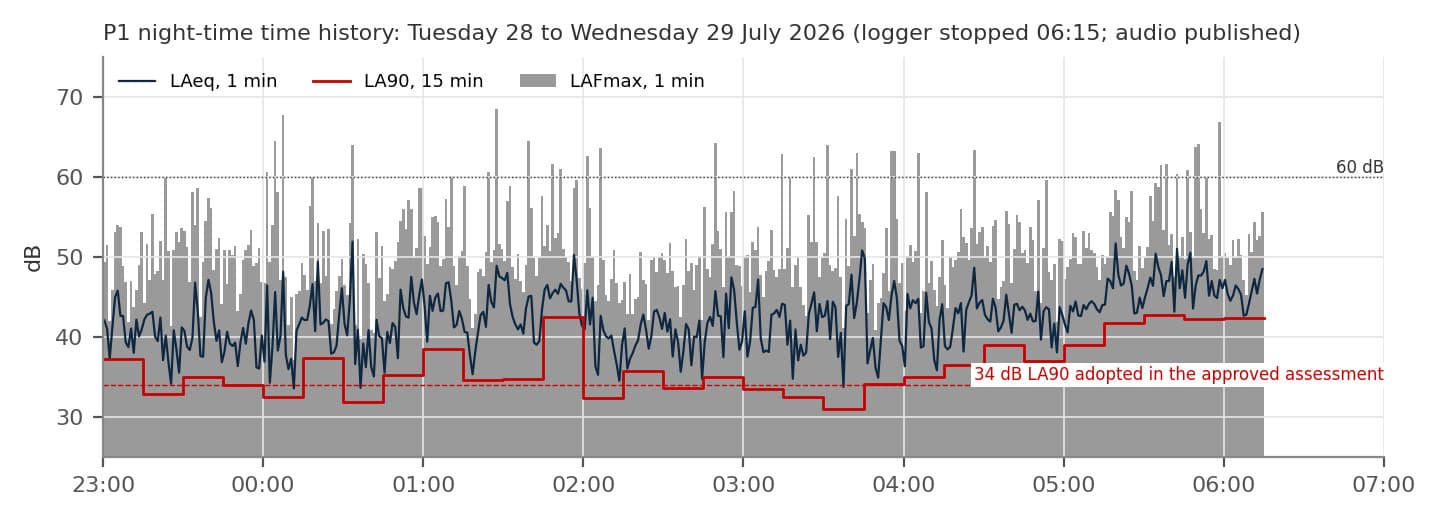
This is the night published at A Night in Astley. The residual sound at P1 without the site is distant traffic on the A580 and the local network, occasional movements on the estate roads, domestic sources and, from about 05:00, birdsong. The sound of the site, identified from the synchronised recording, is heavy goods vehicles moving and manoeuvring in the service yard, engines idling, voices, reversing alarms, air brake releases, and impacts from docking and from coupling and uncoupling trailers. That is a sound which is impulsive, intermittent, and at times tonal.
The assessment that was not made
BS 4142 works by comparing the rating level of a source against the background sound level at the receptor. The specific sound level is what the source produces; the rating level is that level with corrections added for the features that make a sound more noticeable, such as impulsivity, tonality and intermittency. A difference of around +5 dB above the background is likely to indicate an adverse impact. A difference of around +10 dB or more is likely to indicate a significant adverse impact.
The approved assessment identified BS 4142 as its standard and applied it to the 19 rooftop plant items. It did not apply it to the service yard, the docking, the loading or the vehicle activity. Those were assessed instead as noise intrusion: the predicted external level was reduced by an allowance for a partially open window and compared with the World Health Organisation’s internal guideline values. No rating level was derived for them, no comparison with the background sound level was made, and no correction was applied for the character of the sound. No reason for the distinction is given in the document.
The standard was applied to the plant and not to the yard. The yard is the source its own predictions show to be dominant at night.
The consequence can be read from the approved assessment’s own tables. It predicts an external night-time level of 44.8 dB with mitigation at the closest dwelling, and adopts a background sound level of 34 dB at the same receptor. The difference is +10.8 dB before any correction at all. At the next nearest dwelling assessed it is +10.4 dB, and during the daytime at the closest dwelling it is +9.3 dB. The report’s own criteria table treats +10 dB as its trigger for the Significant Observed Adverse Effect Level.
Rated to BS 4142
The background sound level first. The approved assessment adopted 34 dB from a baseline survey carried out in March 2022, four years before the estate became operational. Because the site now runs continuously, no measurement at P1 is entirely free of it, so the measured background is an upper bound and any error overstates it. On the Sunday night, when activity was at its lowest, the most commonly occurring fifteen-minute value was 32 dB. On the two weekday nights it was 36 dB and 35 dB, consistent with a near-continuous contribution from the site lifting the level exceeded for 90% of the time.
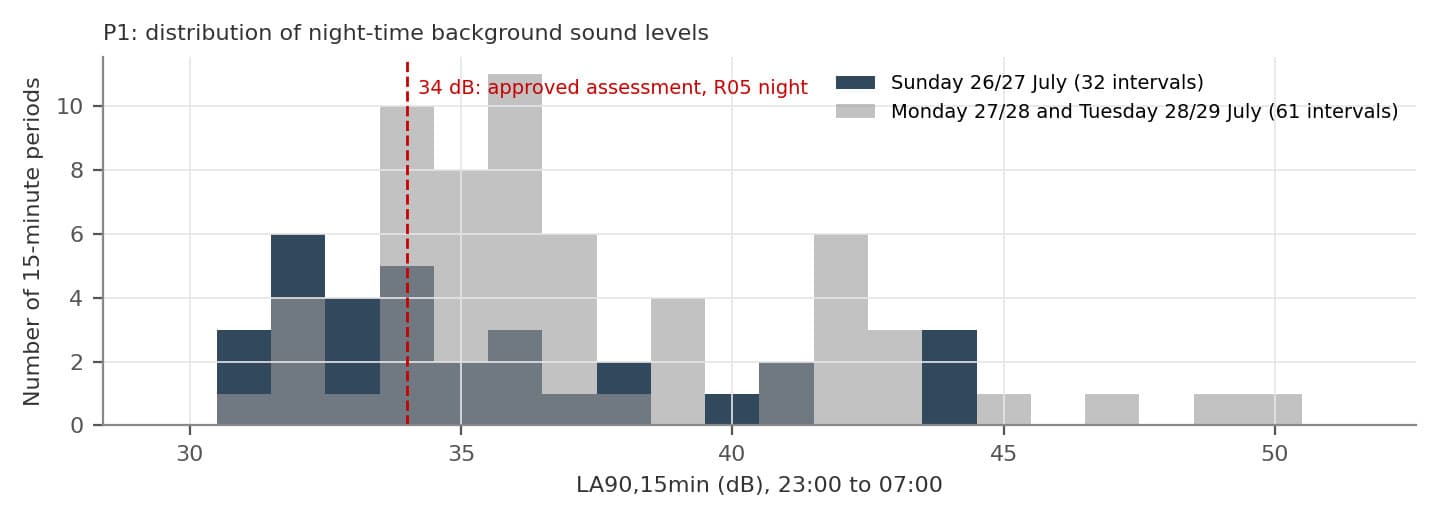
The 34 dB figure is therefore corroborated. The assessment adopts it as its primary basis, so that the comparison is made on the approved assessment’s own terms, and reports the contemporaneous 32 dB alongside it.
The specific sound level is taken from the measured fifteen-minute periods, on the basis that the audio shows the site to dominate them. The highest period between 23:00 and 05:00 on the two weekday nights measured 47 dB. The typical period, the median of all 48 such periods, is 43 dB. A sensitivity case subtracting a conservative residual takes 1 dB off each.
The corrections come next. Dock impacts, trailer coupling and air brake releases are clearly to highly perceptible against a quiet residual, which attracts +6 dB to +9 dB for impulsivity. The vehicle and docking events have identifiable on and off conditions, which attracts +3 dB for intermittency; alternatively the reversing alarms and idling engines attract +2 dB to +4 dB for tonality in its place. The combined correction is between +8 dB and +13 dB, with a central case of +9 dB. As a check, the objective reference methods in the standard’s own annexes were run against the calibrated recording for every fifteen-minute period of the final night: they return impulsivity corrections between 4.9 dB and 9.0 dB in every one of the 28 intervals and perceptible tonality in about half, which brackets the judgement made by ear.
| Case | Specific level | Correction | Rating level | Above 34 dB background | Above 32 dB background |
|---|---|---|---|---|---|
| Highest period, no correction | 47 dB | 0 dB | 47 dB | +13 dB | +15 dB |
| Highest period, +6 impulsive, +3 intermittent | 47 dB | +9 dB | 56 dB | +22 dB | +24 dB |
| Highest period, +9 impulsive, +4 tonal | 47 dB | +13 dB | 60 dB | +26 dB | +28 dB |
| Typical period, no correction | 43 dB | 0 dB | 43 dB | +9 dB | +11 dB |
| Typical period, +6 impulsive, +3 intermittent | 43 dB | +9 dB | 52 dB | +18 dB | +20 dB |
| Typical period, +9 impulsive, +4 tonal | 43 dB | +13 dB | 56 dB | +22 dB | +24 dB |
The standard then requires the initial estimate to be read in context. The absolute levels arise in a residential garden at night where the background sits in the low 30s, which the standard says reinforces rather than moderates the estimate. The residual is distant traffic and the ordinary sounds of a quiet estate, with nothing industrial or impulsive in it, so the site’s sound is incongruous with its surroundings and readily distinguishable in both spectrum and pattern. The houses are modern and double glazed but have no mechanical ventilation or cooling, so bedroom windows are opened in warm weather, and the survey ran in late July with overnight temperatures of 15°C to 19°C. The measurement position understates the levels at those windows. None of it moderates the estimate.
The rating level exceeds the background by a margin the standard associates with a significant adverse impact, in a typical fifteen minutes of the night and not only in the worst.
One limit on that finding is stated plainly in the report. The assessment is A-weighted, and BS 4142 says in terms that it does not apply to low frequency noise. At P1 the C-weighted level exceeded the A-weighted level by a median of 12 dB on both weekday nights, and by up to 17 dB, which is above the threshold at which the WHO guidance recommends a frequency analysis be carried out. The low frequency content of idling and manoeuvring heavy goods vehicles is not captured by the numbers above. The one-third octave data to analyse it exists; the analysis is outside this report’s scope.
On the approved assessment’s own terms
BS 4142 is the assessment we consider appropriate to the source. But the approved assessment judged itself against internal WHO 1999 values, so the report makes that comparison too, using its receptor, its receptor height, its criterion and its window allowances. The transfer from the measurement position to the bedroom window was made by three-dimensional modelling on the approved assessment’s own geometry, buildings and boundary mitigation, with the source levels calibrated to reproduce what was measured.
| Quantity | Approved, mitigated | Approved, unmitigated | Measured at P1, 2.5 m | At the bedroom window, 4.0 m | Criterion |
|---|---|---|---|---|---|
| External maximum | 51.1 dB | 57.2 dB | 68 dB | 71 dB | 60 dB |
| Internal, 15 dB allowance | 36.1 dB | 42.2 dB | 53 dB | 56 dB | 45 dB |
| Internal, 10 dB allowance | 41.1 dB | 47.2 dB | 58 dB | 61 dB | 45 dB |
Read across the top row: the measured external maximum exceeds the mitigated prediction by about 17 dB at the measurement position and 20 dB at the bedroom window, and exceeds the prediction made with no barriers at all by 11 dB and 14 dB. An increase of 10 dB is generally taken as a doubling of perceived loudness.
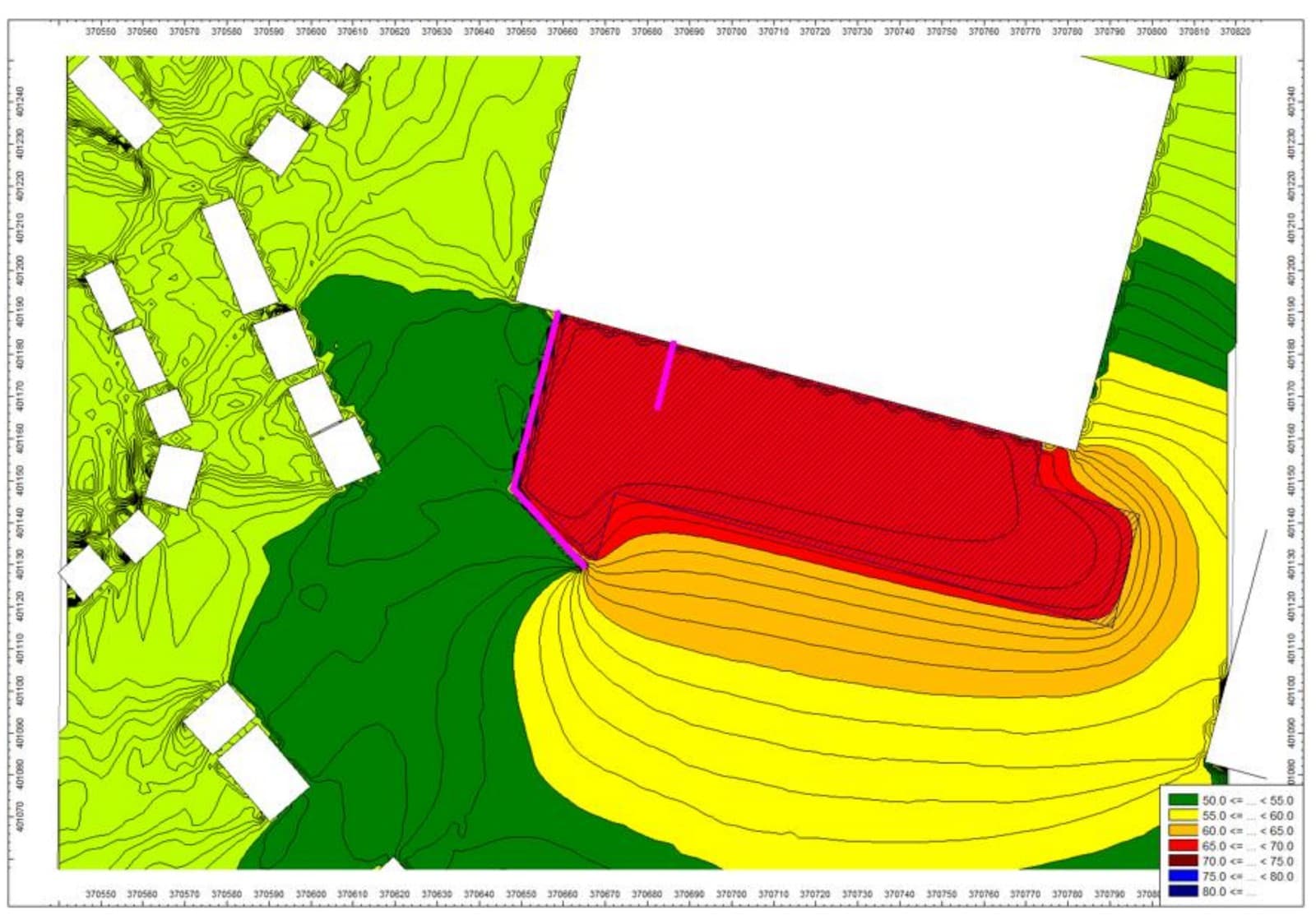
The average levels are a different story, and the report says so. The approved assessment predicted 44.8 dB with mitigation; the measured eight-hour averages at the garden were 46.6 dB and 43.7 dB. On the average, its prediction was close. What it did not do was compare that level with the background, correct it for the character of the sound, or count the events inside it. Those omissions, rather than the arithmetic of propagation, are what separate a conclusion of below the Lowest Observed Adverse Effect Level from the conclusion this report reaches.
Counting the events matters because the WHO guidance the approved assessment took its 45 dB criterion from ties that value to the number of events, and says in terms that an average-based measure alone is inadequate for event noise. An internal 45 dB corresponds to 55 dB to 60 dB outside the window on the approved assessment’s own allowances. At the garden position, lower and better screened than the window, the maximum level reached or exceeded 60 dB in 39 minutes on one weekday night and 30 on the other, and 55 dB in 103 and 79 minutes. The approved assessment predicted no number of events, and the permission limits none.
What the review of the approved assessment found
The report reviews the approved assessment separately from the measurements, on the documents alone, so that each point can be checked against the page cited. In summary:
- The criteria table is internally inconsistent. Its no-effect row transposes the two WHO values so that the bedroom threshold sits above the threshold on the row below it. Its descriptions of the background difference are shifted relative to BS 4142, so that a margin the standard calls an adverse impact is described as a low one. Its action against the significant adverse row is to mitigate where the Planning Practice Guidance says avoid, and it provides no band above that row, so the criteria as framed cannot return an unacceptable outcome.
- The open-window allowance is stated as 10 dB in the method and applied as 15 dB in every assessment table. On the 15 dB figure applied, every dwelling passes the 30 dB night-time average criterion, the closest by 0.2 dB. On the 10 dB figure stated, nine fail it, the closest by 4.8 dB. Both figures sit within the conventional range; the point is that the document states one and applies the other, and that the difference is the difference between passing and failing.
- The night-time case rests on margins of 0.2 dB and 0.6 dB at the two closest dwellings. Those margins depend on the barriers being in the model and on an assumption that half the loading bays are inactive at night. The same document records that docking noise varies between sites by as much as 22 dB and between events at the same site by as much as 14 dB. A margin of 0.2 dB is smaller than the rounding of the result.
- The source levels used for loading and unloading are the lowest the same consultancy appears to have used for the same activity in the same period. Its assessments for two other sites, one issued a month before the Astley report went out to public consultation and one issued eighteen months after that, use figures 8 dB to 9 dB higher for the average level and 4 dB higher for the maximum, and assume every bay active at night rather than half. Nothing here says which dataset is right for Astley. The point is that the document gives no reason for the choice, and that the choice is the difference between the scheme passing and failing its own test. The measurements are more consistent with the higher dataset.
- The barrier scheme changed after the public consultation closed. The revision on deposit during consultation showed four 5 m barrier runs. The revision named in the noise condition, issued the following May, shows two at the yard nearest the houses, one of them reduced in extent, and one shorter 3 m barrier elsewhere. The Environmental Health consultation response recommended its condition by reference to the earlier report.
- In the revision that was approved, the daytime predictions with mitigation are numerically identical, at every one of the 27 receptors and to one decimal place, to the predictions without it. In the earlier revision they differed by 4.6 dB at the closest dwelling. Either the unmitigated run already contained the barriers or the mitigated table was not updated. Either way the approved document does not demonstrate a daytime benefit from the mitigation its condition secures.
- Nothing was assessed for the number of night-time maximum events, for low frequency content, or for garden amenity. No operational noise limit, management plan or monitoring was proposed, and the plant emission limits the assessment relies on are not carried into any condition.
Taken together, and before any measurement at all, those matters mean in our opinion that the conclusion that the development would fall below the Lowest Observed Adverse Effect Level was not supported by the document that reached it.
What the permission actually controls
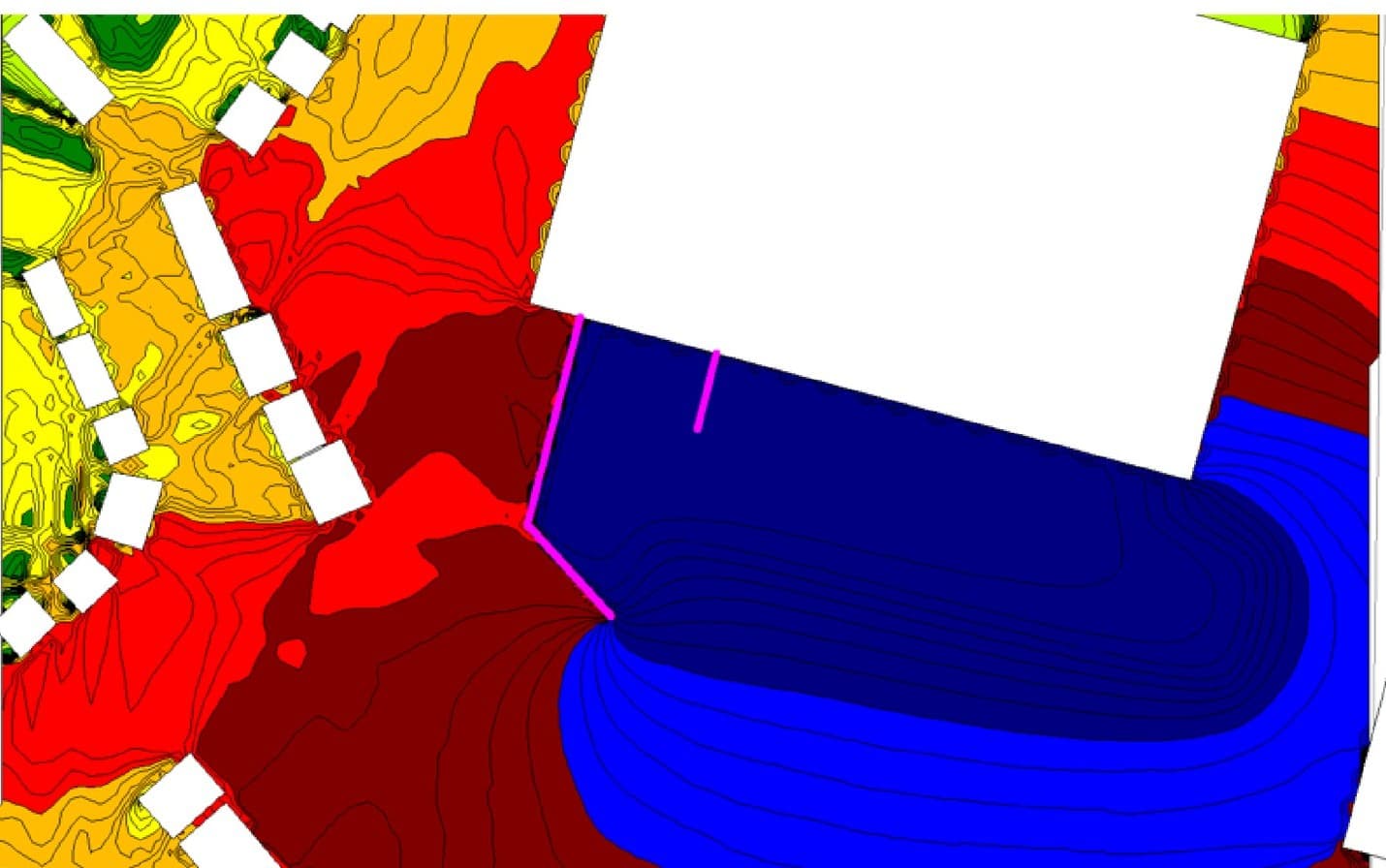
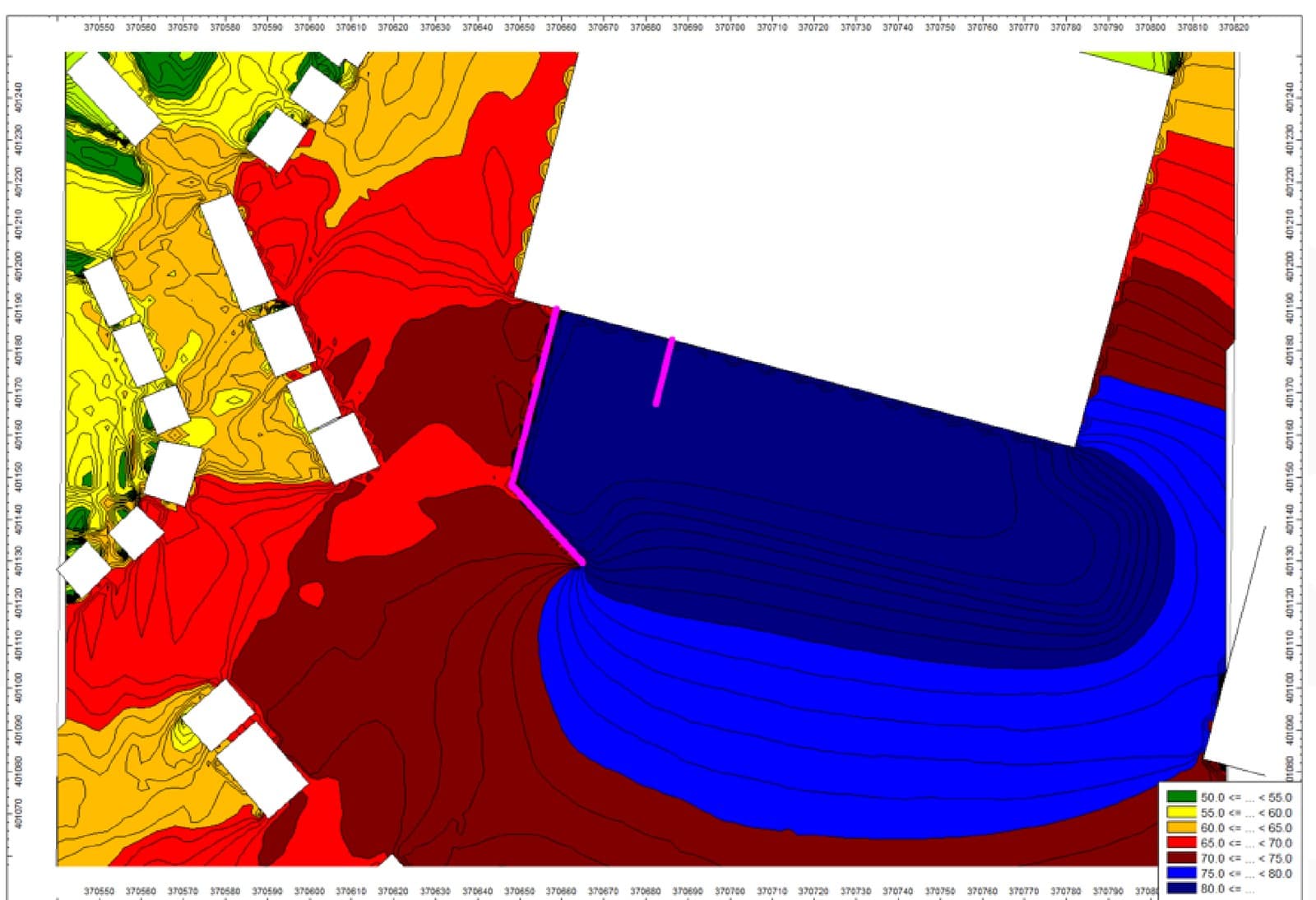
The permission was granted subject to 33 conditions. One relates to operational noise, and it requires acoustic fencing to be installed as detailed in a figure of the noise report before the use commences. That figure is a daytime contour plot drawn not to scale, and the condition specifies neither the length nor the construction of the fencing. There is no numerical noise limit, no restriction on hours of operation or delivery, no limit on vehicle numbers, no requirement for a noise management plan and no requirement for monitoring.
The condition is discharged by building a fence. After that, the permission is silent, however loud the operation becomes.
The same council has, on other industrial and storage permissions in the borough determined under the same local policy, imposed a condition limiting the cumulative BS 4142 rating level at the nearest dwellings to the background sound level by day and 5 dB below it at night, paired with a condition on delivery hours. One such permission was granted eleven months before this one. Had a condition of that kind been imposed here, the measurements in this report would show it exceeded at night by between about 15 dB and 30 dB, depending on the corrections applied.
What the survey does not show
- It was made at one position over four nights, of which two were suitable for assessment. It shows the levels at the nearest gardens on those nights.
- It does not show the levels at other dwellings, except through the modelling reproduced above, which rests on the approved assessment’s own geometry.
- It does not show the daytime position with the same confidence. The daytime data at this position include other nearby commercial and industrial activity that cannot be separated from the site with the confidence the night-time data allow. Nothing in it suggests the daytime picture is more favourable.
- It does not measure the mitigation as built. No conclusion is drawn as to whether the noise condition has been complied with. If the mitigation as built is less than that modelled, the measured levels would be expected to be higher for that reason among others; if it is as modelled, the predictions were wrong for other reasons.
- It does not capture seasonal variation, and it counted neither the bays in use at night nor the vehicle movements.
- The measured levels are total ambient levels. Attribution rests on the audio recording, which is published in full for the final night so that anyone can check it.
The questions the report asks
The report closes with fourteen questions it cannot answer from the documents available, and which in our opinion ought now to be put to those who can. They are questions, not allegations. Each has a factual answer that exists somewhere, and the purpose of listing them is that the answers be produced. In short:
- Which revision of the noise report did the council’s Environmental Health service review?
- What is the council’s standard noise condition, and why was it varied here?
- Why was BS 4142 applied to the fixed plant and not to the service yard?
- Did anyone apply the approved assessment’s own criteria table to its own predictions?
- Which open-window allowance was intended, 10 dB or 15 dB?
- Why are the daytime predictions with and without mitigation identical?
- What were the inputs to the noise model, and will the model files be made available?
- Was the assumption that half the bays are inactive at night ever checked against the operation consented?
- What has been built under the noise condition, and who verified it?
- Are the plant emission limits met by the plant as installed, and how would anyone know?
- How many maximum noise events a night did the council consider acceptable when it accepted the WHO criterion?
- What is the low frequency content of the sound, and has anyone assessed it?
- What assessment of operational noise will the council now require, and from whom?
- What operational controls are in place now, and if there are none, on what basis does the operation run 24 hours a day beside a residential estate without any?
The full wording of each question, with the document references behind it, is at Section 9.0 of the report.
Conclusions
Assessed in accordance with BS 4142, the sound of the operational development at the closest dwellings on Withington Drive is, in the opinion of Murray Acoustics Ltd, likely to give rise to a significant adverse impact at night. It would be so rated even if every distinguishing feature of the sound were disregarded, and it is so in a typical fifteen minutes of the night rather than only in the worst. The conclusion does not turn on decimal places: it holds whether the background is taken as 34 dB or 32 dB, whether or not a residual is subtracted, and at a measurement position that understates what reaches the bedroom windows.
On the approved assessment’s own basis, its night-time maximum criterion is exceeded by a wide margin at the closest dwelling, its night-time average criterion is at best marginal on one window allowance and not met on the other, and its implicit assumption that the number of maximum events would be small is unfounded.
In our opinion the findings warrant a full assessment of operational noise to BS 4142 at several positions, by day and by night, with the cooperation of the operator; verification of the mitigation as built against that modelled; and operational controls on night-time yard activity pending that assessment. The data on which the report relies are available to any party who wishes to check them.
Basis and limitations
- The report was prepared for the Astley Warehouse Action Group and reviews a document issued in the public domain. It makes no comment on the motives of any person or organisation, and none should be inferred.
- It is not a report prepared under Part 35 of the Civil Procedure Rules and is not expert evidence in any proceedings. It does not constitute legal advice, and no opinion is expressed on any question of law, including whether the noise described amounts to a statutory nuisance. Those are matters for the local authority and, ultimately, for a court.
- The findings represent the professional opinion of Murray Acoustics Ltd based on the information available at the time of writing.
- This page is a summary. Where it differs from the report, the report prevails, and its full basis, method and limitations are set out in the document itself.
About the author
Jamie Murray MIOA is Director of Murray Acoustics Ltd, a Member of the Institute of Acoustics with over 12 years in practice, advising developers, local authorities and private clients on environmental and industrial noise, including the assessment of industrial and commercial sound to BS 4142.
Declared interests
Murray Acoustics Ltd was instructed by the Astley Warehouse Action Group. Neither Jamie Murray nor Murray Acoustics Ltd has any commercial or personal interest in the site, in the development, in its developer or in any of its occupiers.
The survey, the assessment and this report have been undertaken without charge to the residents.