
Skip to content
Murray Acoustics
A building junction under construction, showing a twin-leaf wall and a floating floor build-up

Standards reference

The Noise at Work Regulations, explained.

The law that applies when a working day is loud enough to put hearing at risk. Here is what the Control of Noise at Work Regulations 2005 require of an employer, what the action values and the limit value mean, what a noise risk assessment has to contain, and where assessments go wrong.

Control of Noise at Work Regulations 2005

In one paragraph

The Control of Noise at Work Regulations 2005 require employers in Great Britain to reduce the risk from noise to their employees so far as is reasonably practicable. Wherever employees are liable to be exposed at or above a lower exposure action value, the employer must assess that risk, and two trigger points bring further duties. At a daily or weekly personal noise exposure of 80 dB(A), or a peak of 135 dB(C), hearing protection must be available to anyone who asks and staff must be given information and training about the risk. At 85 dB(A), or 137 dB(C) peak, exposure must be reduced to as low a level as is reasonably practicable by a programme of measures other than earplugs or defenders, hearing protection must be provided to those exposed and worn in marked hearing protection zones, and HSE's guidance expects health surveillance for those regularly and frequently exposed at or above it. Exposure at the ear, with protection taken into account, must never exceed 87 dB(A) or 140 dB(C) peak. The noise risk assessment is the document that shows which duties apply to which jobs, and what has been done about them.

What the Noise at Work Regulations are for

Noise-induced hearing loss is permanent, and it is preventable. The Regulations place the main duty to prevent it on the employer, and lesser ones on employees: to use the hearing protection and other controls provided, to report defects, and to attend health surveillance. They came into force on 6 April 2006 for most workplaces and on 6 April 2008 for the music and entertainment sectors, replacing the Noise at Work Regulations 1989, lowering the daily exposure action levels by 5 dB and introducing, for the first time, an exposure limit value.

HSE enforces the Noise at Work Regulations in most workplaces, and the local authority enforces them in premises such as offices, shops, pubs and music venues. HSE publishes the guidance on them, L108, Controlling Noise at Work, which an inspector from either will expect an assessment to follow. The test is not whether the work sounds loud but what each person's exposure adds up to over a shift. Regulation 5 allows that to be estimated from observation of the work and information on the equipment's probable noise levels, and where that will not settle it, measurement does.

The exposure action values and the limit values

  • Lower exposure action values: a daily or weekly personal noise exposure of 80 dB(A), and a peak sound pressure of 135 dB(C)
  • Upper exposure action values: a daily or weekly personal noise exposure of 85 dB(A), and a peak sound pressure of 137 dB(C)
  • Exposure limit values: a daily or weekly personal noise exposure of 87 dB(A), and a peak sound pressure of 140 dB(C)

Regulation 4 of the Noise at Work Regulations sets three pairs of figures. Each pair has an A-weighted value for personal noise exposure, daily (the dose over a working day normalised to eight hours) or weekly (normalised to five eight-hour days), and a C-weighted peak value for sudden impulsive sounds such as hammering, cartridge tools or pressing.

How the values work in practice

The action values take no account of hearing protection. They describe the noise arriving at the person, and they trigger duties. The limit values take the attenuation of any protection worn into account, so they describe what reaches the ear, and they must never be exceeded. Properly worn protectors can keep someone exposed to 95 dB(A) all shift inside the limit, but every duty attached to the upper action value still applies. The limit is a backstop, not a target.

Daily personal noise exposure, written LEP,d, is an energy average. Every 3 dB increase doubles the sound energy and halves the time it takes to reach the same dose. An exposure of 85 dB(A) for eight hours is the same dose as 88 dB(A) for four, 91 dB(A) for two, or 94 dB(A) for one. Weekly exposure, LEP,w, may be used instead where exposure varies markedly from day to day: a fitter who spends one day a week grinding, for example. It is not a way of diluting a consistently noisy job.

What a noise risk assessment must contain

  • The level, type and duration of the exposure, including any exposure to peak sound pressure
  • The effects on any employee whose health is at particular risk, such as anyone with existing hearing damage
  • So far as is practicable, interactions between noise and ototoxic substances and between noise and vibration; and any indirect effects of noise interfering with warning signals or other sounds that need to be heard
  • Manufacturers' information on the noise emission of the equipment in use, and whether quieter alternatives exist
  • Exposure beyond normal working hours, including overtime and time spent in rest facilities supervised by the employer
  • Anything learned from health surveillance, including published information on hearing damage in the trade
  • The availability of hearing protectors with suitable attenuation characteristics
  • Separately, the significant findings and the measures taken or planned must be recorded, and the assessment reviewed regularly and at once if it may no longer be valid or the work has changed significantly. L108 adds that it should be reviewed when working methods, machinery or shift patterns change, when better noise-control techniques become available, when health surveillance shows hearing damage, or when controls once ruled out on cost become reasonably practicable

Regulation 5 requires a suitable and sufficient assessment of the risk wherever employees are liable to be exposed at or above a lower exposure action value. A sheet of meter readings is not an assessment, and neither is a generic document that does not name the jobs on this site. The assessment has to identify who is at risk, estimate their exposure well enough to say which action values are likely to be reached, and record what is being done about it. The Regulations list what it must take into account, and how it is recorded and kept current.

Measurement method and instruments

The Regulations do not prescribe a measurement method. L108 sets out the principles, and BS EN ISO 9612 gives the engineering method that workplace measurement is normally carried out to. BS EN ISO 9612 describes measurement strategies that build the day from individual tasks, sample across a group doing the same job, or cover the whole working day, usually with dosimeters. A good survey often mixes them.

Instruments are specified by class. L108 says sound level meters should be integrating-averaging meters of Class 1 or Class 2, and that personal sound exposure meters, usually called dosimeters, should meet their own instrument standard. Class 2 instruments are acceptable for noise at work measurement. Our sound level meters are Class 1, holding current traceable laboratory calibration certificates and field-checked before and after each deployment. Whatever the class, the meter is checked with an acoustic calibrator before and after each series of measurements, and the readings are discarded if the two checks disagree by more than the tolerance BS EN ISO 9612 allows.

With a hand-held meter the microphone is held close to the ear, on the side of the noisier ear. A dosimeter microphone is mounted on top of the shoulder on the same side, clear of clothing and the wearer's own voice. Dosimeter time histories are inspected and knocks or interference removed rather than averaged in. Every exposure figure carries an uncertainty, and it should be reported with the result.

Controlling exposure at source

  • Other working methods that produce less noise, and quieter equipment when plant is replaced
  • Layout changes that separate noisy processes from the people who do not need to be near them
  • Enclosures, screens, silencers, damping and anti-vibration mounts on the equipment itself
  • Maintenance regimes, because worn bearings, loose guards and leaking compressed air lines are loud
  • Limiting the time anyone spends in the noisiest areas, through rotation and rest facilities away from the noise

Regulation 6 is the one that gets forgotten. The risk from exposure must be eliminated at source or, where that is not reasonably practicable, reduced to as low a level as is reasonably practicable. Where the upper exposure action value is likely to be reached, the employer must put in place a programme of organisational and technical measures to reduce exposure, and hearing protectors are specifically excluded from that programme. Earplugs are the last line, not the plan.

Hearing protection and health surveillance

Hearing protection is governed by Regulation 7. Any area where people are likely to be exposed at or above the upper exposure action value must be designated a hearing protection zone and marked with the standard ear protection sign. Access must be restricted where that is practicable and the risk justifies it. The employer must ensure, so far as is reasonably practicable, that no employee enters without protection. The boundary is drawn from measured levels, not from the edge of the machine. At or above the lower action value, protectors must be made available to any employee who asks. At or above the upper action value they must be provided wherever exposure cannot be brought below that value by other means, and Regulation 8 requires the employer to ensure, so far as is practicable, that they are properly worn.

L108 says protectors must at least bring exposure below the limit values and advises aiming for a level at the ear between 70 and 80 dB(A), avoiding anything below 70 dB(A): over-protection isolates people, hides warning signals and gets protectors taken off. It also advises subtracting 4 dB from the manufacturer's attenuation figure to allow for how protectors are actually worn.

Regulation 9 requires health surveillance wherever the risk assessment shows a risk to health. L108 reads that as everyone likely to be regularly and frequently exposed at or above the upper exposure action value, and anyone exposed between the two action values who is at particular risk. For noise that means audiometry: L108 describes a baseline test, ideally before exposure begins, then annual tests for the first two years and three-yearly tests after that, more often if a change is found. Employees are told their own results, and the employer keeps a health record for each person under surveillance, containing no confidential medical detail. Where a test shows hearing damage, the employer must have the employee examined by a doctor. If the doctor considers the damage likely to be the result of noise exposure, the employer must make sure the employee is told, review the assessment and the controls, consider moving the employee to work with no risk from further exposure, and keep up surveillance while reviewing the health of everyone else similarly exposed.

What HSE expects to see

An inspector checking compliance with the Noise at Work Regulations on a noisy site is likely to start with the noise risk assessment, and the questions that follow are easy to anticipate. Who did it, and were they competent? Does it describe the plant running today? Which action values are reached, and what controls followed? Is the hearing protection adequate, and is it worn? Who is under health surveillance, and what have the results shown?

An improvement notice needs only a breach, not an injury. The gaps that invite one are no assessment at all, an assessment years out of date, exposures above the upper action value with protection as the only control, and no health surveillance where it is plainly required. Each of those is visible in the paperwork before an inspector takes a single reading. The same document is what an insurer asks for when a hearing loss claim arrives.

How a workplace noise survey runs, and why assessments fail

  • Machine sound levels reported instead of personal exposures, so nobody can say what any individual's LEP,d is
  • Measurements taken on a quiet shift, with the noisiest process idle or only part of the plant running
  • Task durations guessed rather than observed, which makes them a major source of uncertainty in a task-based assessment
  • Peak sound pressure not measured where impact noise is present, so the 135, 137 and 140 dB(C) values are never checked
  • Hearing protection treated as the control measure, with no programme of technical and organisational measures where the upper action value is reached
  • Protectors chosen by subtracting the SNR from an A-weighted level rather than the C-weighted level it applies to, with no 4 dB real-world correction and no check for over-protection
  • No health surveillance despite regular and frequent exposures at or above 85 dB(A), or results filed and never acted on
  • An assessment years out of date, describing plant that has been replaced or a layout that no longer exists

A workplace noise survey starts with a work analysis: the processes, the job roles, the shift pattern and what a normal day looks like, because a survey measured on an unrepresentative day describes nobody's exposure. The work analysis then sets the strategy for each job: task-based measurement with a hand-held meter where the day breaks into clear tasks, dosimeters where people move between areas or the pattern is unpredictable. Levels are measured at operator positions, task durations are observed rather than estimated, and peaks are taken wherever impact noise is present. The calculation gives an LEP,d for each job role, with its uncertainty, set against the action and limit values. Our noise at work service page sets out how that assessment is scoped and delivered.

Assessments we are asked to review fail in the same few ways.

Questions

Noise at Work Regulations: common questions.

Who do the Noise at Work Regulations apply to?

Every employer in Great Britain whose work exposes employees to noise must reduce the risk so far as is reasonably practicable. The specific duties, starting with the risk assessment, apply wherever employees are liable to be exposed at or above a lower exposure action value: 80 dB(A) daily or weekly exposure, or 135 dB(C) peak. Some self-employed people are covered too, where health and safety law applies to their work. The duties also extend, so far as is reasonably practicable, to anyone else at work who may be affected, such as contractors' staff, though health surveillance is owed only to employees. There is no exemption by size of business.

What is the difference between an exposure action value and an exposure limit value?

An action value triggers duties and is assessed without any allowance for hearing protection: it describes the noise arriving at the person. The limit value of 87 dB(A), and 140 dB(C) peak, takes the attenuation of the protection worn into account, describes what actually reaches the ear, and must never be exceeded. Reaching an action value means doing something; exceeding the limit value is a breach in itself.

What is LEP,d and how is it calculated?

LEP,d is daily personal noise exposure: the A-weighted sound energy a person receives over their actual working day, expressed as the steady level that would deliver the same energy in eight hours. It is built from the measured level of each task and the time spent on it. Because it is an energy average, each 3 dB increase halves the time that produces the same dose, so an hour at 94 dB(A) equals eight hours at 85 dB(A).

Can a Class 2 sound level meter be used for a noise at work assessment?

Yes. L108 accepts integrating-averaging sound level meters of Class 1 or Class 2, and dosimeters to their own instrument standard, provided each is checked with an acoustic calibrator before and after use and periodically verified by a laboratory. Class 1 meters have tighter tolerances than Class 2, but a calibrated Class 2 meter used properly gives a valid exposure figure.

When is health surveillance required under the Noise at Work Regulations?

Where the risk assessment indicates a risk to health, which L108 reads as anyone likely to be regularly and frequently exposed at or above the upper exposure action value of 85 dB(A), and anyone exposed between 80 and 85 dB(A) who is at particular risk, such as someone with existing hearing damage. It takes the form of audiometry: a baseline test, annual tests for two years, then three-yearly.

Does issuing hearing protection satisfy the Regulations?

No. Where exposure is likely to reach the upper action value the employer must reduce exposure by a programme of technical and organisational measures from which hearing protectors are specifically excluded. Protection must be provided as well, and worn in marked hearing protection zones, but a workplace that relies on earplugs alone has not met Regulation 6.

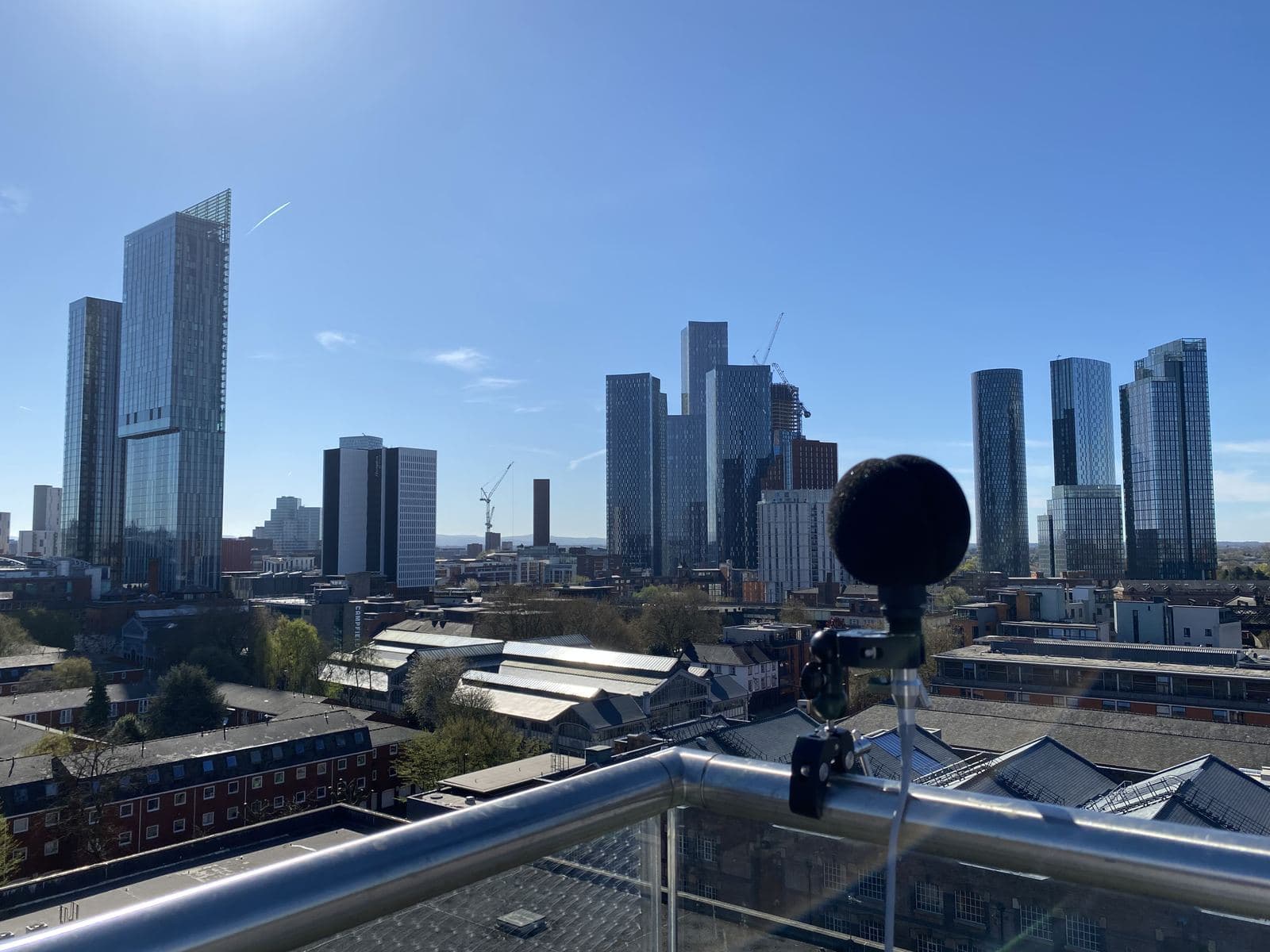
A sound level meter monitoring overnight on a Manchester rooftop

Need a Noise at Work Regulations assessment?

Send a postcode and a sentence. We're ready to price it right now.